Saturday, May 29, 2010

Polish Constitution of 3rd May 1791


Constitution of 3 May, 1791 is considered as first European and second in modern world codified constitution. It was adopted by Sejm (parliament) of Polish-Lithuanian Commonwealth.

The main idea of the constitution was to reform political system of Commonwealth. Old privileges for nobility, known as Golden Liberty were very good for them, but not for all society. Rules, such as liberum veto (every deputy had the right to undo legislation passed by Sejm) led the country to anarchy and corruption. Commonwealth was under influence of its neighbors, especially Russia. After First Partition of Poland in 1772 many people realized, that lots of things in the country have to be repaired and that old system may lead Poland only into destruction. That’s why, after four years of debates the constitution was adopted by Polish king Stanislaw August Poniatowski and many prejudiced deputes during the gathering of the Great Sejm, on 3 May, 1791 in Warsaw.

The Constitution introduced political equality between townspeople and nobility and placed the peasants under the protection of the government, abolished pernicious parliamentary institutions such as the liberum veto. The Constitution sought to supplant the existing anarchy fostered by some of the country's magnates, with a more democratic constitutional monarchy.

Despite the fact that constitution was in effect for only a year, it was a great achievement of Polish society. Unfortunately, after Russo-Polish War in 1792, when defenders of the Constitution were beaten by Russian army supported by Targowicka confederation, Constitution was annulled. This situation led to Second and Third Partition of Poland (in 1793 and 1795). After that Poland was erased from the map of Europe for next 123 years.

In the words of two of Constitution’s co-authors, Ignacy Potocki and Hugo Kołłątaj, it was "the last will and testament of the expiring Motherland”. 3rd May is now a holiday, celebrated in whole country.The constitution led to the creation of the first constitutional monarchy in the world and thus was recognized by political scientists as a very progressive document for its time—for generations it helped keep alive Polish aspirations for an independent and just society, and continues to inform the efforts of its authors' descendants. In Poland it is viewed as the culmination of all that was good and enlightened in Polish history and culture. The May 3 anniversary of its adoption has been observed as Poland's most important civil holiday since Poland regained independence in 1918.

These charters of government form an important milestone in the history of democracy. Poland and the United States, though distant geographically, showed some notable similarities in their approaches to the design of political systems. By contrast to the great absolute monarchies, both countries were remarkably democratic. The kings of the Polish–Lithuanian Commonwealth were elected, and the Commonwealth's parliament (the Sejm) possessed extensive legislative authority. Under the May 3 Constitution, Poland afforded political privileges to its townspeople and to its nobility (the szlachta), which formed some ten percent of the country's population. This percentage closely approximated the extent of political access in contemporary America, where effective suffrage was limited to male property owners.

The defeat of Poland's liberals was but a temporary setback to the cause of democracy. The destruction of the Polish state only slowed the expansion of democracy, by then already established in North America. Democratic movements soon began undermining the absolute monarchies of Europe. The May 3 Constitution was translated, in abridged form, into French, German and English. French revolutionaries toasted King Stanisław August and the Constitution—not only for their progressive character, but because the War in Defense of the Constitution and the Kościuszko Uprising tied up appreciable Russian and Prussian forces that could not therefore be used against Revolutionary France. Thomas Paine regarded the May 3 Constitution as a great breakthrough. Edmund Burke described it as "the noblest benefit received by any nation at any time... Stanislas II has earned a place among the greatest kings and statesmen in history." In the end, the conservatives managed to delay the ascent of democracy in Europe only for a century; after the First World War, most of the European absolute monarchies were replaced by democratic states, including the reborn, Second Polish Republic.

by Jakub Bieda

Thursday, May 20, 2010

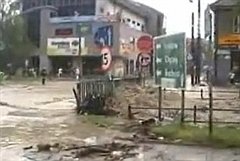
Torrential rain has caused heavy flooding across southern Poland


This week's floods have left few unaffected, as the heavy rainfall has left its mark on many spheres – business, social and political.

Thousands of people have been evacuated from their homes in southern Poland with the water levels of some rivers reaching up to 7.45 meters. Rescue workers have been working around the clock, building temporary levies in an attempt to stop the water from spreading into the cities.


Heavy rains that began in central Europe last weekend are causing flooding in areas of Hungary, Poland, Slovakia and the Czech Republic, with rivers bursting their banks and inundating low-lying homes and roads, and cutting off villages. Rail travel is also paralyzed in places, rendering some areas unreachable.

In Krakow, continuing heavy rain led the Mayor of Krakow, Jacek Majchrowski, to declare a state of emergency at 22:00 Sunday night, after the Vistula rose above emergency levels in the city. Many other towns across the region have followed suit. In Krakow three major bridges have been closed as the Vistula River nearly reached them. Many regional roads in the province have been closed, as well as in the city of Krakow, some of whose main arteries near the river Vistula have flooded. The Krakow-Zakopane train line is also affected by the adverse weather conditions.

At Auschwitz-Birkenau, the former Nazi death camp that draws about a million visitors a year, authorities carried historical documents and some artifacts, including brushes and bowls that belonged to victims, to the upper floors of old barracks that are used to house exhibits. Officials closed the Auschwitz-Birkenau memorial site on Tuesday to protect its Holocaust archives.

Flash floods in Poland turned more dramatic Thursday as the swollen Vistula River broke its dykes near Sandomierz, central Poland, spilling into the town of 25,000 residents and stretching as far as seven kilometers from the usual stream channel. Many have been stranded in their homes in villages near Sandomierz, with water five to six meters deep. They are unable to call for help as power outages have made phone communication impossible in some areas. Thursday morning, news channel TVN24 showed live footage of the area, taken from a helicopter, with people on rooftops waving white cloth. The situation worsened in many regions as people refuse to leave their homes for fear their abandoned property would be looted.

Meanwhile, the peak wave on the Vistula is moving north faster than expected and is likely to reach Warsaw late Thursday afternoon. The head of the regional government told a news briefing this morning that river banks in Warsaw could withstand water as deep as eight meters, while the forecast peak level is seen around 7.8 meters, the highest level in the country’s post-war history.

Poland will likely ask the EU for financial help to cope with damage caused by the floods. To be eligible for assistance from the so-called EU Solidarity Fund, the damage must exceed €2 billion.“We fear that the damage may be even bigger,” Prime Minister Donald Tusk told a news briefing overnight before embarking on more tours of the flooded regions.

Thursday, April 22, 2010

The Katyn forest massacre


> For Poles, Katyn is a symbol of the criminal policy of the Soviet system
> against the Polish nation. In the Polish-Soviet relations in the years
> 1917-1991, Katyn is the culminating moment. The "Katyn Massacre" is a
> symbolic term, referring to one of the places of extermination of the
> Polish leading elite during the Second World War, the first to be
> discovered - the Katyn forest near Smolensk.

> The Katyn Massacre was the secret execution by the Soviets of almost
> 22,000 citizens of the Polish state who - after the Red Army entered Poland
> on 17 September 1939 - were taken prisoner or arrested. Pursuant to a
> secret decision of the Politburo of the Central Committee of the Communist
> Party of the Soviet Union (Bolsheviks) of 5 March 1940, approximately
> 15,000 POWs, previously held in special NKVD camps in Kozelsk, Ostashkov
> and Starobilsk, and 7,000 persons interned in prisons of the western
> district of the Ukrainian and Belarusian republic, i.e. the eastern
> territories of Poland included into the Soviet Union in 1939, were killed
> with a shot in the back of the head.

>> The victims were mainly important citizens of the Polish state: officers
> of the Polish Army and the Police, officials of the state administration,
> and representatives of intellectual and cultural elites in Poland. They
> were buried anonymously in mass graves, in at least five places within the
> territory of the Soviet Union. In April-May 1940, POWs from three special
> NKVD camps were transported by trains to the places of execution: Katyn
> (from the Kozelsk camp), Kalinin (from the Ostashkov camp), from Kharkiv
> (Starobilsk camp). Those killed in Kalinin (currently Tver) were buried in
> Mednoye. Others, held in prisons and murdered there, were buried in
> previously undetermined places; two are known: in the Belarusian Republic
> and the Ukrainian Republic of the USSR (Kuropaty near Minsk and Bykivnia
> near Kiev).

>> After the outbreak of the German-Soviet war and the Polish
> Government-in-Exile initiating official relations with the Government of
> the Soviet Union in the summer of 1941, the Soviet authorities failed to
> provide Poles - despite their efforts - with any information concerning
> those "missing in action". The Soviet Union broke the alliance in April
> 1943, when the German Army stationed in the Smolensk region discovered a
> burial ground in the Katyn Forest and attacked the Soviet Union for
> propaganda purposes. Soviet authorities responded with the tactic of
> pinning the blame on the Germans who had allegedly murdered Poles after
> entering those territories in 1941. Stalin, using the pretext of "slander
> against the USSR", broke relations with the Polish Government-in-Exile (in
> London).

>> The "Katyn" case was one the best guarded secrets of the Kremlin during
> the entire USSR period. When, after the end of the Second World War, during
> the Nuremberg Trials, the Soviet Union failed to pin the blame for the
> massacre on the Germans (but at the same time managed to avoid being judged
> for its deeds), the Soviet authorities permanently adopted the
> interpretation of the "Katyn lie", in defiance of the facts: the Soviets
> had nothing to do with the massacre of Polish officers - German fascism is
> responsible for everything...

> The Katyn Massacre was not an isolated event. It was the consequence of
> system differences, the Soviet attempt at creating a state of the world
> proletariat, and the growing hostility between the Soviet Russia and the
> pre-war Poland. When, after the end of the Polish-Bolshevik war in 1920,
> which was victorious for Poland, the Soviets had to give up the export of
> the revolution to the West for many years, and Stalin himself was
> criticised for his significant mistakes on the Polish front - the Soviet
> authorities accepted their Western neighbour to be their main enemy. During
> the Great Terror in the USSR in the years 1937-1938, which was aimed at
> pacifying the anti-Bolshevik mutiny brewing in the whole of Russia, the
> Soviets fought Polish groups in their territories with extreme fierceness.
> Over 70,000 Poles (Soviet citizens) were killed with a shot to the back of
> the head at that time. One in every ten victims of the Great Terror was
> related to Poland. The mechanism of mass exterminations was fine-tuned in
> the USSR then.

> When in September 1939 Stalin, after entering into an alliance with
> Hitler, attacked Poland defending itself against the Germans, one of his
> aims was to permanently destroy the Polish statehood. From the very first
> moments of that aggression, the Soviets consistently isolated (or killed on
> the spot) those people whom they regarded to be representatives of the
> group of leaders of the state that was being destroyed, and particularly
> the officers. One might imagine that the Soviet authorities planned their
> systemic elimination in advance - just as it was planned by the Nazis in
> "their" part of the occupied Poland. With regard to those prisoners the
> Soviet did not apply the rules of international law, that is why they held
> on to the lie they devised with such consistency.

> After the relations with Poland were severed in 1943, and after the Soviet
> Union took control of Poland's territory in the years 1944-1945, it
> controlled the subjugated country, ruled by puppet governments subordinated
> to the communist empire, well into the eighties. During that period, the
> demands for the truth about "Katyn" were treated as an act hostile not only
> against the USSR but also the People's Republic of Poland. This is because
> the post-war Poland was harnessed to the "Katyn lie".

> After the system changes in the entire Soviet bloc (1989-1991), the demand
> for the explanation of the truth about "Katyn" also appeared on the Russian
> side. Many Russians helped in discovering the truth about that crime. In
> the years 1990-1992 the main "Katyn" documents were disclosed, including
> the decision of the Politburo of the Central Committee of the Communist
> Party of the Soviet Union (b) of 5 March 1940, signed among others by
> Stalin. In August 1993, a group of Russian historians developed an
> exhaustive expert appraisal in Moscow, presenting honestly the process of
> the crime and the subsequent lies.

> Those guilty of this crime have never been judged. Although the people who
> made the decision are known, as are over one hundred executioners (the list
> of persons rewarded for the "camp clearing" campaign was disclosed).
> However, the investigation on the Russian side was discontinued, and the
> Russian authorities refuse to make any comments on this subject. No one has
> been and no one will be punished for the crime.

> There is a material trace of the crime. Three cemeteries built by the
> Poles - in Katyn, Mednoye and Kharkiv - where each and every one from among
> almost 15,000 Polish POWs is commemorated by name. This is an exception
> among the graveyards remaining after the crimes of the Soviet power.

Russian and Polish prime ministers honour the WWII Katyn massacre

In an unprecedented move, the Russian and Polish prime ministers on Wednesday 7th April honoured together 22,000 Polish officers murdered 70 years ago by the Soviets in the WWII Katyn massacre.


Russia's Vladimir Putin and Poland's Donald Tusk paid their respects to Soviet victims of Stalinist-era terror campaigns buried next to Polish officers in the Katyn Forest, near Smolensk, western Russia.

Soviet NKVD secret police massacred Polish military elites mobilised to combat Nazi Germany's September 1, 1939 attack on Poland after they were captured by the Red Army following its September 17 invasion from the east.

Although the slaughter was committed in several places, Katyn has become its chief symbol.
It also represents what was perhaps the most flagrant lie proffered for half a century by Soviet propaganda, which long claimed Nazi Germany was to blame.

Although in 1990 then Soviet leader Mikhail Gorbachev admitted that Moscow was responsible, even today few Russians -- long fed on Soviet propaganda -- know the truth about Katyn.

The memory of Katyn remains a painful issue in Polish-Russian relations, which have often been tense since Poland peacefully threw off communism and Soviet dominance in 1989, joining NATO in 1999 and the EU in 2004.

Russian courts have classified the vast majority of files in the Katyn massacre case, making it impossible to access information that could prove helpful in finding those still missing.

On March 5, the Russian NGO "Memorial" called on President Dmitry Medvedev to reopen the investigation into this "war crime and crime against humanity".

As a sign of the new openness on this question earlier this month, Russia's public Kultura television channel aired "Katyn", a film by Polish director Andrzej Wajda about the massacre.

After the ceremonies at the cemetery in Katyn, Putin and Tusk had a face-to-face talk in nearby Smolensk during a meeting of a joint task-force on "difficult issues" in bilateral relations.

Among the most contentious issues, was Poland's decision to host US Patriot missiles on its soil and the possible involvement of Warsaw in the new version of a planned US missile shield.
Both are the source of considerable concern for the Kremlin.

Poland for its part has opposed the joint Russian-German NordStream project to build a natural gas pipeline across the Baltic Sea floor, thus bypassing Polish territory. Warsaw sees this as a threat to its energy security, not to mention lost gas transit earnings.

Sunday, April 18, 2010

Sicily - a memorable trip

First day
Monday 22nd March

The welcoming reception was truly exceptional with all the colours of traditional costumes and sounds of lively music. The headmaster opened the day with his speech to greet us whole heartedly. We could try dancing different traditional dances ourselves, enjoy delicious Sicilian food prepared by our hosts and play games that we were teaching each other. All to be followed by a little more serious exchange of information about our countries, traditions and customs.

Our Palermo trip

Tuesday 23rd March
Text and photos by Szymon Bartuś (Kolegium Europjskie, Cracow, Poland)

During the second day of our stay in Sicily, we had a pleasure to do sightseeing in its capital city, Palermo. The trip was led by a professional guide and was very rich in historical sights.
We began our tour by visiting the gardens of San Giovanni degli Eremiti church. The church itself is quite an extraordinary building, dating back to the 6th century and being influenced by both Muslim and Byzantine civilizations. But for me and my group, the largest impression was made by its gardens. We were very surprised to see oranges simply growing on trees, looking ready to be collected (Pic. 1. – 2.). Oranges are obviously known and popular fruits in Poland but because of the local climate they can’t be grown there, so very few people have any idea what orange trees look like. There was also a grenade tree in the garden - in our region grenades are almost unknown.
Next, we had quite a long walk, during which we saw the ruins of an ancient Roman mansion (Pic. 3.) – a reminder that Palermo is indeed an ancient city. During the walk we also passed the Quattro Canti square, known for its Baroque architecture (Pic. 4.). Our trip arrived in the front of Fontana Pretoria at Piazza Pretoria square (Pic. 5.). The fountain itself is one of the primary examples of renaissance style in the city. It turns out that the structure was first built in Florence (in 1555) and about 20 years later bought by the Senate of Palermo. It was dismantled, transported to Sicily and assembled again. On the side of the fountain, the building of Sicilian government is located. There were even some protests in the front of it as we were walking nearby! The next sight was San Cataldo church (Pic. 6.), built around 1160 and notable for its Arab-style exterior and red domes (the guide told us that Islamic influences are very widespread in Palermo’s architecture). The last church we visited was the largest one – the huge Palermo Cathedral (Pic. 7.). Our formal trip concluded with a bus ride around the city, during which we could see the coast and botanical gardens.
After the scheduled sightseeing every person had a free lunch time. It definitely appealed to me as I find Italian cuisine quite delicious. All Polish students went together to one restaurant and spend some good time together. Finally, the bus took us back to Alcamo.

Selinunte Temples and Mazara del Vallo
Wednesday 24th March

Text and photos by Virginia Wąsikowska (Kolegium Europjskie, Cracow, Poland)
The third day of our trip didn’t promise very optimistic – the sky was covered by a thick layer of clouds and there was a rain threatening. Like previously, the bus was waiting by the castle, at the Piazza della Repubblica. At 8.00, when everyone sat down comfortably in the bus, we finally set off to Selinunte.
Selinunte is located on the south coast of Sicily, in the province of Trapani. Situated in a strategic point between two rivers, Belice and Modione, Selinunte used to be one of the most important Greek colonies in Sicily. The main point of our trip was the complex of temples, or I should rather say it’s ruins as out of five temples only one, known as the Temple of Hera, has been reconstructed. By the time we reached Selinunte the weather cleared up and we eagerly started the walk. The most remarkable places were the Temple of Hera (also called the Temple E) and the ruins of the biggest temple in the area - Temple G.

There’s an interesting curiosity connected with the place’s name, which – according to etymologists - have been derived from wild parsley, which grew in large quantities on the spot. The parsley leaf was also adopted by the citizens of Selinunte as the symbol on coins.
When the sightseeing came to an end everyone was hungry, so we had lunch in Selinunte, at one of the restaurants with the wonderful view on the sea. Then, we could relax on the beach and sunbath a little bit.
We sent the afternoon in Mazara del Vallo, sightseeing it’s old city center, however the most interesting was the Museum of the dancing Satyr – Greek statue made of bronze. In 1997 on the southern coast of Sicily a fishing boat fished out the leg of the statue. The discovery was so outstanding that the boat’s crew decided to throw its nets in the same place in order to find the rest of the sculpture and after a year, in March 1998 the crew find the torso of the sculpture. The sculpture is dated in the early 2nd century CE. Although some parts of the figure are missing (arms, one leg, tail) it is very well preserved, despite millennia spent at the bottom of the sea. Unfortunately, we weren’t allowed to take photos there.
We finished the trip with the diner at “Baglio Giorlando” and then set back to Alcamo.

Erice and Trapani
Next, we were off to the town of Trapani, right on the coast, with part of the older section jutting out. Drove past vast expanses of salt pans where salt production has been carried on commercially for centuries. Trapani also produces a lot of vineyards & olives.

Another town we visited was the medieval town of Erice with its stunning views and wonderful surrounding coastline. Old Norman castles (around 11th century) sit precariously at the very edge of the cliffs as you approach on foot.The old town looks just like one imagines it might have almost 1000 years ago! Small, narrow, cobbled streets suitable only for pedestrian traffic these days, but once the routes for small carts drawn by horse, abound (you can still see rows of wider pavers marking where the cart wheels were positioned in days gone by). Lovely old churches, shops, eateries, etc everywhere.... we could sample famous local almond/sugar sweets.

And in the Evening back to Alcamo to feast on real! Pizzas and sing some karaoke during the farewell party.

Riserva Naturale Orientata Zingaro
Friday 26th March

Text and photos by Iwetta Musiał (Kolegium Europjskie, Cracow, Poland)
We have visited Zingaro Reserve, a real paradise of nature for the great variety of natural environments. It is located near the sea and the coast opens towards it with high and indented calcareous walls interrupted by inlets, rocky ravines, and caves.
From the sea level to the highest peak Mt. Speziale (913 m above the sea level) we have met different kinds of ecosystems, all extremely significant.
The landscape is characterized by harsh and rough shapes. In the most open places, where steep slopes and heaps of stone dominate, many reptiles live: small like the gecko and the hemidactylus (they can climb on vertical walls thanks to the thin hooked lamella present under the fingers), or the ocellated skink, similar to a lizard with short legs, or the two species of lizard (Sicilian and Italian Wall Lizard).
This year, there are some organisations working in the environmental and in the cultural field, such as "La Poiana", whose members have a lot of experience in the environmental field, and the Archaeological Association "Dreapanon", belonging to the Archaeology Groups of Italy, whose archeo-trekking combine archaeology with the pleasure of an outdoor walk. These associations give an extraordinary contribution to promote the knowledge of the wonderful island, rich in natural, environmental and artistic beauties, protecting the wild animals.


Polish, foreign leaders attend Kaczynski funeral in Kraków


KRAKOW, Poland (Reuters) – Polish and foreign leaders attended a funeral mass on Sunday for President Lech Kaczynski and his wife Maria, but a volcanic ash cloud over Europe prevented some overseas guests from joining them.

U.S. President Barack Obama was among those forced by the ash cloud to abandon plans to attend the funeral in Krakow for the Kaczynskis, killed on April 10 with 94 other, mostly senior, political and military officials in a plane crash in Russia.

However, Russia's President Dmitry Medvedev managed to fly to the city, reinforcing a strong message of Russian solidarity since the crash that has raised Polish hopes for an improvement in long-strained ties with their communist-era overlord.

Cardinal Stanislaw Dziwisz praised Russia during the funeral mass, which was held in St Mary's Basilica, a mediaeval church famed for housing Europe's largest carved Gothic altar.

"The tragedy of eight days ago and the sympathy and help extended by the Russians in these days give us hope for better relations between our two great nations. I direct those words to Mr President Medvedev," Dziwisz said.

Nearby, the coffins of Poland's first couple were both draped with the red and white national flag.Kaczynski's daughter Marta and his twin brother Jaroslaw, who heads Poland's main opposition party, led the mourners. They had insisted the funeral go ahead on Sunday, despite the ash cloud that has closed Polish and other European airports.

Other mourners included Poland's interim President Bronislaw Komorowski, Prime Minister Donald Tusk and his government and the presidents of Ukraine, the Czech Republic, Hungary, Slovakia, Romania and Georgia.

UNPRECEDENTED MOURNING

Outside, an estimated 50,000 mourners watched the mass on large screens. The Kaczynskis' coffins were later to be taken to Wawel cathedral where they would be laid to rest in a crypt normally reserved for Polish kings, national heroes and poets.

The funeral crowns a week of unprecedented national mourning for the Kaczynskis and the 94 others who perished in the crash.

In Warsaw, Poles had queued through Saturday night to view the coffins while they remained on public display. Early on Sunday, the coffins were flown by military plane to Krakow at a low altitude because of the volcanic ash cloud.

Obama said he regretted being unable to attend the funeral.

"President Kaczynski was a patriot and close friend and ally of the United States, as were those who died alongside him, and the American people will never forget the lives they led," Obama said in a statement.

Poland, part of the Soviet bloc during the Cold War, is now a member of NATO and a close U.S. ally.

Chancellor Angela Merkel of Germany, Poland's biggest trade partner, also expressed regret at having to scrap her trip. But Germany's president and foreign minister joined the funeral after flying to Krakow from Berlin by helicopter.

Medvedev's presence was ironic, given that Kaczynski was a stern critic of what he called Russia's "imperialism" toward ex-Soviet republics such as Georgia and Ukraine. During his five years as president, Kaczynski never visited Moscow.

Kaczynski's plane crashed while heading to Katyn forest in western Russia to commemorate the 70th anniversary of the massacre of 22,000 Polish officers and intellectuals by the Soviet secret police.

Wawel cathedral was the coronation site of virtually all of Poland's monarchs and the adjacent castle was the center of government for five centuries until the end of the 16th century. Some Poles have staged protest rallies and joined petitions on social media site Facebook against the decision to bury Kaczynski in such a hallowed spot.

Kaczynski was a polarizing figure whose support levels had fallen to about 20 percent before his death. He had been expected to lose a presidential election due in the autumn and now likely to be held on June 20.

The protests were the first cracks in an otherwise remarkable display of national unity since the crash.

By Gabriela Baczynska and Wojciech Zurawski

Tuesday, March 23, 2010

Welcome Spring!!!


It happended. The first day of spring, the 21st of March was two days ago. And that means that the warmth and brightness of spring will be with us for another three months ;). In Poland, the First Day of Spring is an important event with many customs and traditions. They have been all preserved from pagan times, when the Mother Earth was worshipped by the Slavs. Accompanying those customs were magical rituals believed to bring energy to homes and the joy of life and ensure a good harvest and success throughout the whole year. The most common and popular practice was (symbolizing the expulsion of winter) the drowning or burning straw effigy called Marzanna. After the ritual symbolic ban of winter, it was turn to welcome spring. Men used to ignite fires on the hills, which were expected to ensure the coming of spring and sunny days. Young people would set off to the meadows and the woods in search of willow and hazel - covered with buds - the so-called catkins or "Bazie". Women used to clean the whole house and bake special spring cakes. The most important, however, was painting eggs - a Proto-Slavic symbol of life, fertility and magical vital force. Easter egg was in fact a particular element of the magical rituals that was to provide health and fertility not only to the members of the household but also the animals. In some regions, a colourful processions consisting of both human and animals were organised in order to manifestate the fact that spring had come.

Customs are of course important but spring means also longer days, warm weather and smiling faces so let's cherish this beautiful time of year!!!

Monday, March 8, 2010

Women's Day


Women’s Day is celebrated on 8th March. It’s a great occasion for men to show their respect to women – to give flowers or chocolates, to say how important they are to them. There are many votes against this holiday, but mainly because people don’t know its history.For many years Women’s Day was celebrated ostentatiously. Nowadays many man use to say that it was created by communists, and need to force themselves to give flowers, or any other gifts to women on 8th March. But in fact this holiday was “invented” by US women in 1909, before communism in Poland. Its history goes back to March 8th almost 150 years ago - in 1857 when women from New York City stopped work in protest of bad working conditions, a long working day (12 hours), and low pay. The march that started in a poor neighborhood was brutally broken up by police when the women reached the wealthy district of town. A similar march took place 50 years later; this one was triggered by the death of 126 women killed when they were trapped on a high floor in Triangle Shirtwaist Factory in New York City. Their slogan was "bread and roses" -"bread" for economical security and "roses" for a better life. The remembrance of this day was eventually adopted by a conference of Socialist Women in Copenhagen in 1910, the year when Women's Day was created.


In our country it started to be celebrated after the Second World War, it matched to the socialistic propaganda, that’s why a lot of us call it the communistic holiday and refuse to celebrate it. Throughout Communism in Poland, this day of the woman was very important and was celebrated with the most possible attention, because it went well with the propaganda of success, so much liked by the socialist power. The Polish women were thus honoured obligatorily by their partner, and received flowers and symbolic gifts. At schools, the pupils thanked their teachers by offering flowers and gifts (for example "laurki" - the hand made cards by the youngest were very current). The men colleagues offered flowers to their women colleagues. This traditional day was officially suppressed in Poland in 1993. In spite of that, many people still celebrate it, even today. What can be interesting: in particular the younger generations are favourable and for a few years, the interest for the International Day of the Women in Poland has increased. Obviously, that does not mean that Polish men offer flowers to their favourite women (as well their wives, mothers, daughters or sisters, colleagues) only on the 8th of March. Quite the contrary, because Polish men are very courteous and polite!!!